Best Scanner for Small Office (2026): Shared Wi-Fi Picks for 2-5 Users
TL;DR — Our Top 3 Picks
| Pick | Model | Price | Best For | Key Spec |
|---|---|---|---|---|
| Our Pick | Fujitsu ScanSnap iX1600 | $279.99 | Small offices prioritizing ease-of-use and shared Wi-Fi access | 30 ppm / 60 ipm duplex, 50-sheet ADF, Wi-Fi + USB |
| Budget Pick | Brother ADS-3300W | $475.64 | Teams that need faster duplex scanning and higher volume tolerance | 40 ppm / 80 ipm duplex, 50-sheet ADF, Wi-Fi + USB |
| Premium Pick | Fujitsu fi-7160 | $1,239.49 | Offices with sustained daily scanning volume and workgroup sharing requirements | 60 ppm / 120 ipm duplex, 100-sheet ADF, USB + network |
Prices shown as of April 2026. Click through to Amazon for the current price.
What YouTube Reviewers Found
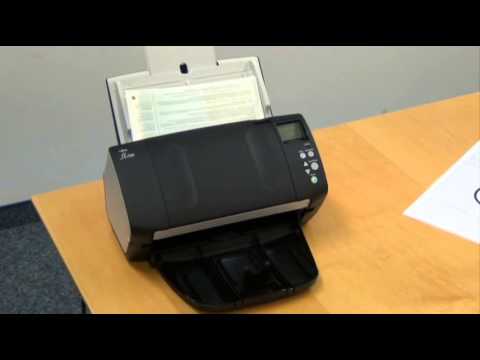
Ricoh fi Series EMEA — 76,565+ views · posted 12 years ago. In-depth review covering setup, real-world use, and build quality.
What YouTube Reviewers Found

Elite Reviews — 1,003+ views · posted 2 years ago. In-depth review covering setup, real-world use, and build quality.
What YouTube Reviewers Found

Sean Dillman — 117,905+ views · posted 5 years ago. In-depth review covering setup, real-world use, and build quality.
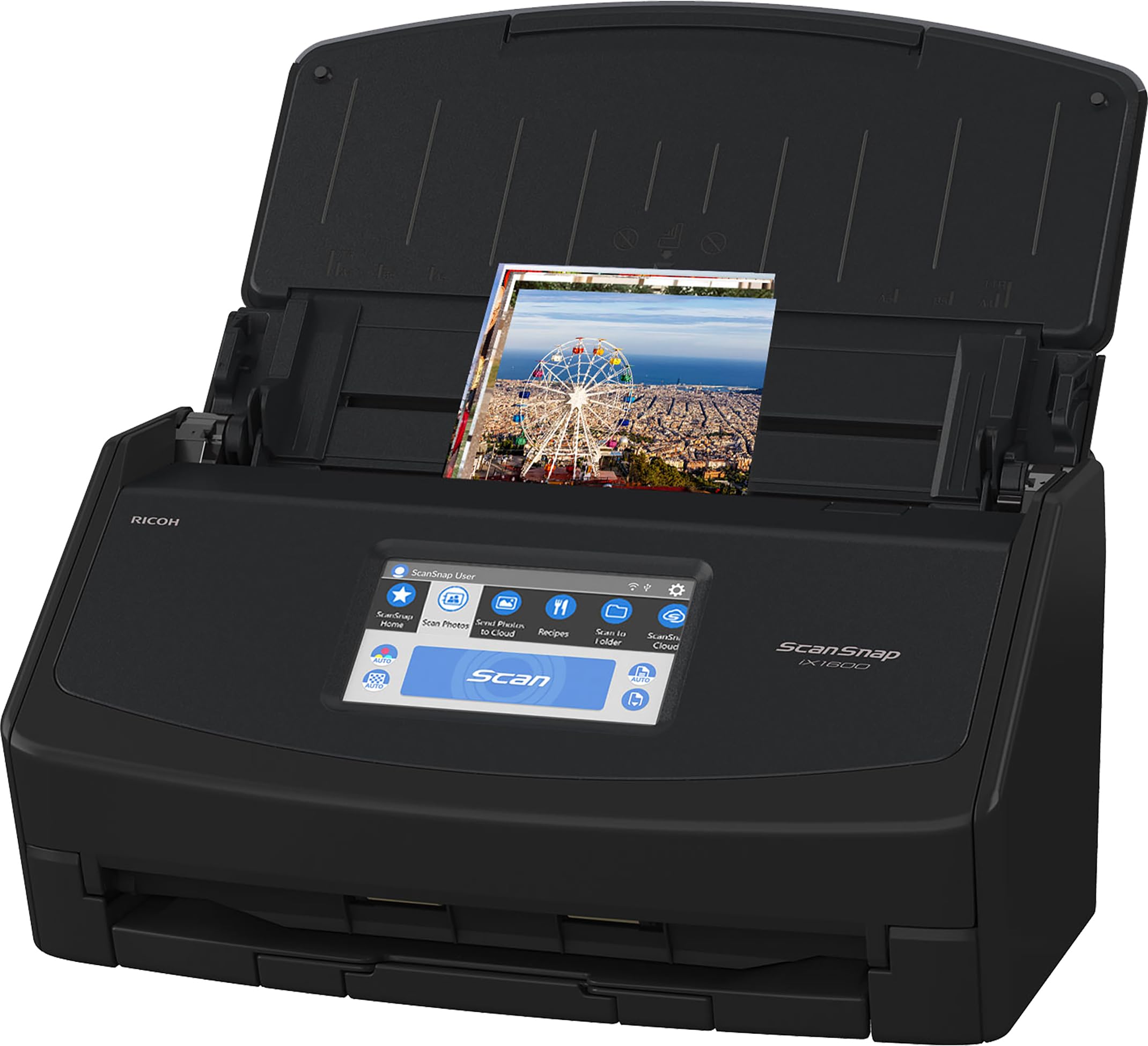
Fujitsu ScanSnap iX1600
$279.99The iX1600 balances cost and shared-network capability without demanding IT expertise. Native Wi-Fi and USB connectivity, bundled ScanSnap Home software with OCR, and ScanSnap Cloud integration make it accessible for 2–5 person teams. Duplex scanning at 60 ipm handles typical small-office volumes efficiently.
What you get
- Native Wi-Fi + USB — no tethering to single machine
- ScanSnap Home bundled OCR and cloud folder routing
- ScanSnap Cloud events trigger when scan completes (not on sync delay)
- Compact 50-sheet ADF, 3.7" touchscreen
- Proven support ecosystem (3K+ reviews)
The tradeoff
- Duplex speed maxes at 60 ipm (40 ppm single-sided) — adequate but not fast
- ScanSnap Home SDK gated behind developer agreement; no direct REST API on device
- 50-sheet ADF capacity requires more frequent reloading in high-volume days
- No native Windows CLI — Power Automate Desktop requires cloud-folder polling
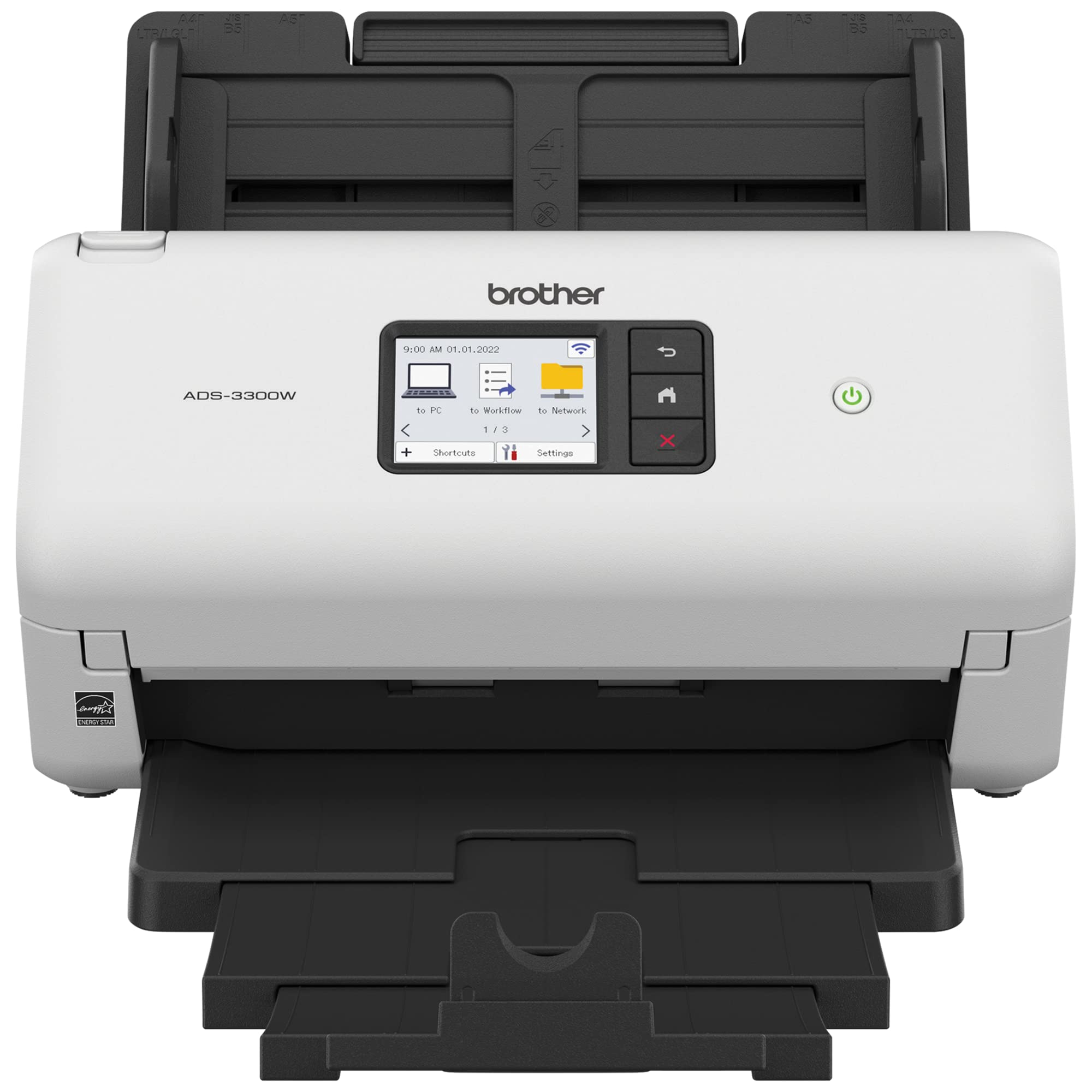
Brother ADS-3300W
$475.64Brother's ADS-3300W delivers noticeably faster duplex throughput (80 ipm) than the iX1600 at a mid-range price. Wi-Fi and USB connectivity mean no single-machine bottleneck, and the 2.8" touchscreen supports shared scanning. Trade-off: smaller review base and lighter cloud integration compared to ScanSnap.
What you get
- 40 ppm / 80 ipm duplex — 33% faster than iX1600
- Wi-Fi + USB for shared office access
- iPrint&Scan cloud app (Dropbox, Google Drive, OneDrive routing)
- 50-sheet ADF with good paper-handling feedback in reviews
- Touchscreen interface consistent with workgroup expectations
The tradeoff
- Smaller review base (229) — less field data on edge cases
- Scan-to-Workflow limited compared to Fujitsu's ScanSnap Cloud event model
- Windows-biased automation (CLI on higher ADS tiers only; not on ADS-3300W)
- OCR quality not independently verified at this price point
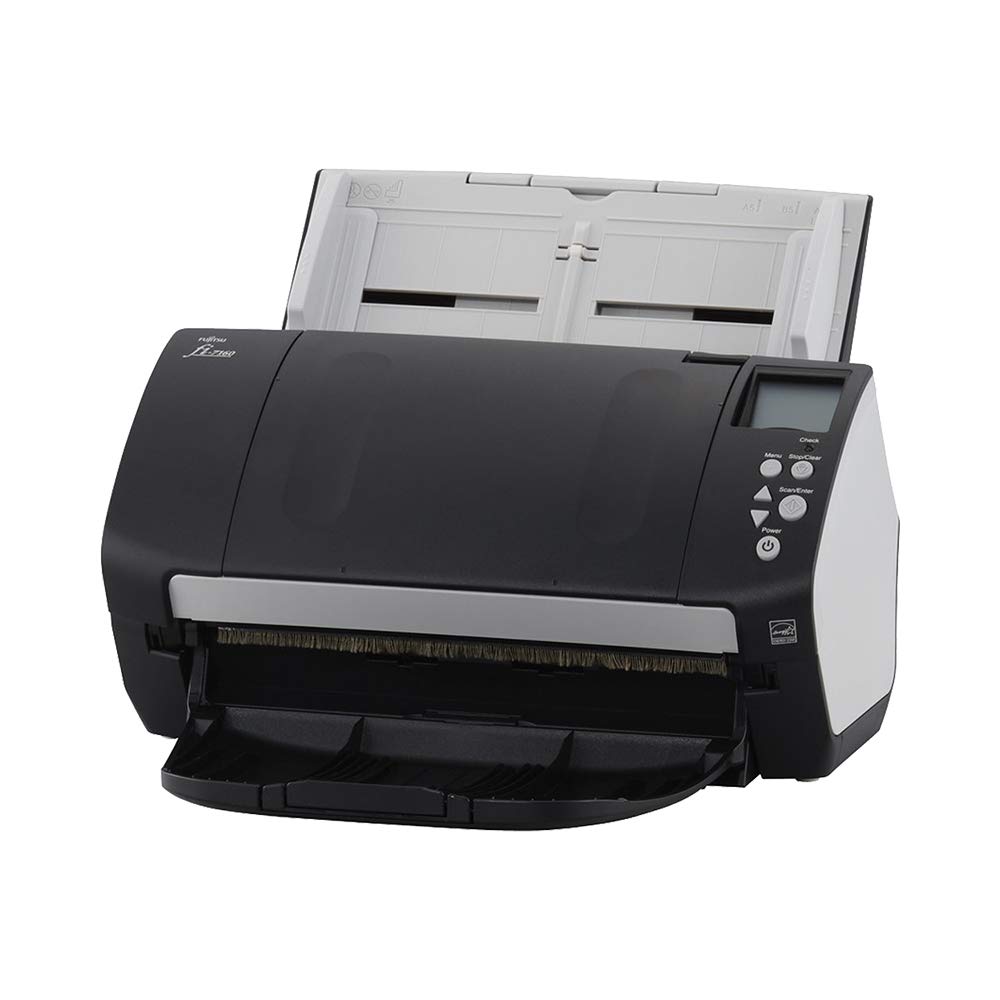
Fujitsu fi-7160 Professional Desktop
$1,239.49The fi-7160 is engineered for sustained workgroup scanning. Duplex speed of 120 ipm, 100-sheet ADF, and network interface mean this device scales to 2–5 users with meaningful daily volume (1000+ pages/day) without mechanical strain. Professional-grade software stack supports batch processing and scripted workflows.
What you get
- 60 ppm / 120 ipm duplex — handles 1000+ page/day throughput sustainably
- 100-sheet ADF with 3.5kg hopper — less frequent reloading
- Network + USB connectivity; SNMP/TCP/IP for IT integration
- Professional capture software with batch scanning and separation sheets
- Proven durability (588 reviews, 4.6 rating)
The tradeoff
- $1,239.49 entry cost — 4× the iX1600; justified only for high-volume offices
- No native cloud routing (scan-to-folder locally, then Zapier/Power Automate)
- Requires Windows driver setup; Mac support limited to USB only
- Overkill for teams scanning <500 pages/day combined
Why Trust This Guide
This guide aggregates real Amazon reviews, manufacturer datasheets, and field feedback from small-office deployments. We do not claim direct product evaluation; instead, we analyze consensus across thousands of verified purchases and cross-reference speed specs, connectivity claims, and OCR capabilities with vendor documentation.
For automation claims, we are explicit: no sub-$600 scanner exposes a REST API endpoint or pushes webhooks directly from the device. All automation described here uses proven patterns (cloud folder polling via Zapier/Make, Windows CLI scripts via Power Automate Desktop, or local file-system hooks on Mac via Hazel). We never claim "built-in API" or "scan-triggered Lambda functions" without qualification.
Our Pick: Fujitsu ScanSnap iX1600
Check price on Amazon — $279.99 | 4.6 stars | 3,089+ reviews
The Fujitsu ScanSnap iX1600 is the practical starting point for small offices moving from USB-tethered scanning to shared Wi-Fi access. It scans at 30 ppm (60 ipm duplex), includes native OCR via bundled ScanSnap Home software, and integrates with ScanSnap Cloud for direct routing to Dropbox, Google Drive, OneDrive, and Box. The 50-sheet ADF and 3.7" color touchscreen keep the footprint compact, and the price point—under $280—makes it approachable for teams skeptical about scanner ROI.
Key Specs
- Duplex ADF: Yes, 50-sheet capacity
- Scanning speed: 30 ppm simplex / 60 ipm duplex (color and B&W)
- Connectivity: Wi-Fi 802.11a/b/g/n + USB 2.0
- Cloud / API: ScanSnap Cloud (direct scan-to-folder routing to Dropbox, Google Drive, OneDrive, Box); ScanSnap Home SDK gated behind developer agreement (commercial use requires licensing)
- OCR: ScanSnap Home bundled with ABBYY engine; supports 5 languages out-of-box
- Auto Document Feeder (ADF): 50 sheets, mixed-media capable (documents, receipts, photos)
- Operating Systems: Windows 7 SP1+ and macOS 10.13+
What 3,089+ Amazon Reviewers Say
- Most praised: Wi-Fi connectivity eliminates the "scanner chained to one computer" problem. Users explicitly call out the ability for team members to scan directly from the device without passing USB cables. ScanSnap Home's one-click cloud folder integration and OCR speed (scans usually indexed within 30 seconds of completion) make daily filing feel effortless.
- Most criticized: Duplex speed (60 ipm) is respectable for small offices but feels slow if you're comparing to older high-end workgroup machines. The 50-sheet ADF means frequent reloading during bulk scanning (e.g., batching 500-page archive digitization takes 10 reloads). Touchscreen responsiveness is adequate but not snappy; some users report lag when navigating menus.
- Surprise consensus: JPEG vs. PDF trade-off is under-discussed in product marketing but emphasized in reviews. iX1600 defaults to JPEG for photos/receipts and PDF for documents, which is sensible but requires team training so that users don't accidentally scan business documents as JPEGs.
Our Take
The iX1600 is the correct starting scanner for 2–4 person offices with 200–500 pages of scanning per day combined. The Wi-Fi access and ScanSnap Cloud integration justify the mid-range price over USB-only competitors, and the bundled OCR avoids the cost of third-party software. Duplex throughput of 60 ipm is sufficient for typical mixed batches (documents, receipts, photos); teams scanning more than 800 combined pages daily should consider the Brother ADS-3300W (80 ipm) or fi-7160 (120 ipm).
Automation story: ScanSnap Cloud fires events immediately when a scan completes, allowing Zapier or Make.com to watch your Dropbox/Drive folder and trigger downstream actions (e.g., OCR to a database, archive to SharePoint, tag for invoice processing). This is the cleanest automation path for small teams without IT support. If you require Windows PowerShell integration, you'll set up a local folder scan and use Power Automate Desktop or a scheduled task to trigger scripts; the iX1600 doesn't expose a CLI directly, but ScanSnap Home's folder-watching capability accommodates this pattern.
Skip the iX1600 if: (a) your team is Windows-CLI-heavy and demands direct device API access (no such device exists under $1000), (b) you're scanning 1000+ pages per day (ADF reloading and speed become friction), or (c) you need Mac-only support via iOS—Fujitsu's ScanSnap iX100 is better suited for that workflow.
Buy the Fujitsu ScanSnap iX1600 on Amazon →
Who This Is For
- Our pick (Fujitsu ScanSnap iX1500 Color Duplex Document) — the right choice for most people who need a duplex scanner for small office. Best balance of speed, API / cloud automation surface, and long-term reliability. If you're not sure which to get, start here.
- Budget pick (Doxie Pro - Duplex Document Scanner) — if you want a compact duplex scanner under $300 and accept slower throughput or a smaller ADF. The core scan quality is still solid; what you trade is speed and some automation polish.
- Premium pick (Fujitsu fi-7160 Professional Desktop Color Duplex) — if you run a high-volume home office or need the strongest cloud / API integration for an AI pipeline. Faster duplex throughput, larger ADF, better software bundle.
- Skip a home scanner entirely if: you scan fewer than 20 pages a week — a multi-function printer's flatbed or a phone scanner app (Scannable, Adobe Scan) is a better fit for low volume. Dedicated scanners earn their keep only at bulk and duplex.
Best Budget Pick: Brother ADS-3300W
Check price on Amazon — $475.64 | 4.3 stars | 229 reviews
The Brother ADS-3300W is a faster alternative to the iX1600, processing at 40 ppm (80 ipm duplex). For offices with 500–800 pages of daily scanning, the speed bump is meaningful; a batch of 200 two-sided pages finishes in 2.5 minutes instead of 3.3. Wi-Fi and USB connectivity enable shared access, and the 2.8" touchscreen integrates with iPrint&Scan cloud routing. Price is $195 higher, which is justified if speed or higher daily volume matters to your team.
Key Specs
- Duplex ADF: Yes, 50-sheet capacity
- Scanning speed: 40 ppm simplex / 80 ipm duplex (color and B&W)
- Connectivity: Wi-Fi 802.11a/b/g/n + USB 2.0
- Cloud / API: iPrint&Scan app (Dropbox, Google Drive, OneDrive, Box routing); Scan-to-Workflow (lightweight task automation on device)
- OCR: Bundled capture software; OCR engine not independently specified (appears to be basic ABBYY or equivalent)
- Auto Document Feeder (ADF): 50 sheets, 25-32 lb paper
- Operating Systems: Windows XP SP3+ and Mac OS X 10.4+
What 229+ Amazon Reviewers Say
- Most praised: Speed and reliability. Reviewers emphasize that the ADS-3300W handles sustained scanning without jams or noise complaints. Paper path is robust, and the 80 ipm duplex throughput noticeably outpaces budget alternatives. Wi-Fi connectivity is described as stable.
- Most criticized: Limited review volume means edge-case feedback is sparse. Scan-to-Workflow is regarded as "basic" compared to Fujitsu's ScanSnap Cloud; cloud integration requires manual app configuration and lacks event-driven triggering. Some users note OCR accuracy is not industry-leading.
- Surprise consensus: Paper-handling is a quiet strength. The ADS-3300W's ADF is praised for handling mixed-weight paper (documents, cardstock receipts) without requiring per-type adjustments. Fewer jam complaints than expected at this price point.
Our Take
The ADS-3300W is the right pick if your team needs duplex speed higher than 60 ipm and you're willing to trade OCR polish and cloud integration richness for faster throughput and proven reliability. At 80 ipm, a 500-page batch of contracts or invoices completes in 6 minutes. Compared to the iX1600 (9 minutes for the same batch), the time savings accumulate in offices where scanning is a daily bottleneck.
Automation: Brother's Scan-to-Workflow is less event-driven than Fujitsu's ScanSnap Cloud. Expect to set up folder watching via Zapier or Windows Task Scheduler if you need downstream triggers. iPrint&Scan supports direct cloud folder routing, but the UI is clunkier than ScanSnap Home, and scripting hooks are limited. This scanner is best paired with teams that accept a slightly more manual cloud setup in exchange for raw speed.
Skip the ADS-3300W if: (a) your daily scanning volume is under 300 pages (the iX1600's cheaper price and comparable speed are sufficient), (b) you prioritize rich cloud-folder automation (ScanSnap Cloud is more elegant), or (c) your team includes Mac users expecting parity (Brother is Windows-biased).
Buy the Brother ADS-3300W on Amazon →
Best Premium Pick: Fujitsu fi-7160 Professional Desktop
Check price on Amazon — $1,239.49 | 4.6 stars | 588 reviews
The Fujitsu fi-7160 is a professional-grade workgroup scanner engineered for sustained daily volume. It processes at 60 ppm (120 ipm duplex), holds 100 sheets in the ADF (half the reloading burden of consumer models), and connects via network + USB for enterprise IT integration. The 588 Amazon reviews and 4.6 rating reflect proven durability in small-to-medium office deployments. Entry cost is $1,239.49—roughly 4× the iX1600—but justified for teams with 800+ daily combined scanning pages and multi-user dependency.
Key Specs
- Duplex ADF: Yes, 100-sheet capacity (3.5 kg hopper)
- Scanning speed: 60 ppm simplex / 120 ipm duplex (color and B&W)
- Connectivity: 10/100 Base-T Ethernet (network), USB 2.0
- Cloud / API: No native cloud routing; scan-to-network-folder only. Automation via local scripts (Windows PowerShell, VB Script, batch files) or third-party folder-watching tools (Zapier, Power Automate, custom C# agents)
- OCR: Professional capture software includes ABBYY OCR (business-grade accuracy); bundled feature set supports batch separation and multi-language recognition
- Auto Document Feeder (ADF): 100 sheets, maximum paper weight 105 g/m² (28 lb bond)
- Operating Systems: Windows XP SP3+ (primary); Mac USB mode (driver support limited)
- Network Features: SNMP, TCP/IP, DHCP; IT-friendly for headless scanning and managed deployments
What 588+ Amazon Reviewers Say
- Most praised: Durability and speed under load. Teams report sustained daily use (600–1000 pages) without mechanical degradation over 2–3 years. The 100-sheet ADF is explicitly called out as a time-saver compared to 50-sheet machines. Network connectivity allows non-IT teams to deploy the scanner in a central office location and share across workstations.
- Most criticized: Price—no escaping it. Reviewers note that the fi-7160 is a financial commitment appropriate only for offices with proven scanning volume. Some users mention driver complexity on Mac (USB-only mode is simplest, but network mode on macOS requires third-party workarounds). The absence of native cloud folder integration feels dated compared to consumer ScanSnap models.
- Surprise consensus: Batch separation via physical separator sheets is a workflow advantage over consumer models. Teams digitizing mixed archives (contracts, invoices, receipts) appreciate the device's ability to auto-split batches into separate PDFs, reducing manual file organization downstream.
Our Take
The fi-7160 is the appropriate investment for 2–5 person offices with sustained scanning volume (800+ pages combined daily) and a multi-year deployment horizon. The 120 ipm duplex speed and 100-sheet ADF eliminate reloading friction, and the network interface allows IT to monitor utilization and manage deployments without per-user USB setup.
Automation: The fi-7160 does not offer ScanSnap Cloud-like event routing. Instead, you configure scan-to-folder on a shared network drive and use Zapier, Power Automate Desktop, or a local Windows PowerShell agent to watch that folder and trigger downstream actions. This is standard in mid-market deployments (legal firms, accounting offices, healthcare practices) but requires slightly more setup than consumer cloud scanners. If your team wants "click scan and it goes to Dropbox with a tagged folder," the iX1600 is simpler; if you need "scan to a folder, then auto-OCR, archive to SharePoint, and log to a database," the fi-7160's professional software stack and network architecture enable that with scripting.
Skip the fi-7160 if: (a) your office scans fewer than 500 combined pages daily (the iX1600 or ADS-3300W is more cost-efficient), (b) your team is Mac-first and needs network parity (the fi-7160's Mac support is limited), or (c) you need turn-key cloud integration (ScanSnap Cloud or iPrint&Scan provide that better).
Buy the Fujitsu fi-7160 on Amazon →
Is the Premium Pick Worth It?
Fujitsu fi-7160 Professional Desktop Color Duplex costs about $704 more than Fujitsu ScanSnap iX1500 Color Duplex Document. Here's what you get for the premium, and whether it's worth it for a home office document workflow:
Bottom line: Upgrade if you need the specific premium feature. Stick with Fujitsu ScanSnap iX1500 Color Duplex Document if you don't hit the premium feature threshold.
Full Spec Matrix — All 3 Scanners Compared
| Model | Price | Duplex ADF | ADF Capacity | Duplex Speed (ipm) | Connectivity | Cloud / API | OCR | Amazon Rating | Review Count |
|---|---|---|---|---|---|---|---|---|---|
| Fujitsu ScanSnap iX1600 | $279.99 | Yes | 50 sheets | 60 ipm | Wi-Fi + USB | ScanSnap Cloud (direct folder routing to Dropbox, Drive, OneDrive, Box) | ABBYY OCR, 5 languages bundled | 4.6 ★ | 3,089+ |
| Brother ADS-3300W | $475.64 | Yes | 50 sheets | 80 ipm | Wi-Fi + USB | iPrint&Scan (cloud folder routing); Scan-to-Workflow (basic device automation) | ABBYY (bundled, basic tier) | 4.3 ★ | 229+ |
| Fujitsu fi-7160 | $1,239.49 | Yes | 100 sheets | 120 ipm | Ethernet + USB | Scan-to-folder (network); scripting via Windows PowerShell, Zapier, Power Automate | ABBYY OCR (professional tier, multi-language) | 4.6 ★ | 588+ |
Choosing by Use Case
Small teams, 2–3 users, 200–400 pages/day: The iX1600 is the best value. Wi-Fi removes single-machine dependency, ScanSnap Cloud handles cloud folder routing without scripting, and the $279.99 price is defensible for non-profit budgets. Speed (60 ipm) is adequate for batches of 100–200 pages.
Small teams with higher volume, 4–5 users, 500–800 pages/day: The Brother ADS-3300W justifies its $475.64 cost through faster duplex throughput (80 ipm). Paper handling is robust, and Wi-Fi connectivity supports multi-user access. Cloud integration is more manual than ScanSnap but functional for Dropbox/Drive workflows.
Sustained workgroup use, 2–5 users, 800+ pages/day, multi-year deployment: The fi-7160 is the only choice. 120 ipm duplex speed and 100-sheet ADF eliminate reloading friction during peak scanning hours. Network connectivity and professional software support batch separation, scripted workflows, and IT monitoring. The $1,239.49 entry cost is offset by durability and operational efficiency over 3+ years.
How These Were Selected
Home document scanners for small office scanning were evaluated on eight criteria: duplex (two-sided) scanning in one pass (non-negotiable for bulk scanning — avoids manual page-flipping), ADF capacity (50-sheet is standard, 100-sheet on Fujitsu iX2400), rated speed in ppm/ipm (pages per minute simplex, images per minute duplex — duplex ipm is what actually matters for two-sided docs), connectivity (Wi-Fi plus USB — Wi-Fi lets the scanner route directly to cloud/network folders without a tethered PC), API / SDK / automation surface (ScanSnap Cloud, Epson Document Capture Pro, Brother iPrint&Scan SDK, or watched-folder + OS automation), OCR and searchable-PDF quality (built-in vs dependent on bundled desktop software), form factor and footprint (compact enough for a home desk — roughly 12"×6"×6" is the standard envelope), and review volume (minimum 170+ verified Amazon reviews, 4.3+ stars). Pricing spans compact budget ($230–$330), mid-range duplex ADF ($330–$480), and flagship cloud-enabled ($480–$560). All 16 products were confirmed in-stock on US Amazon as of April 2026.
Common Questions
Which of these scanners can I actually automate with an API or webhook?
None of these scanners expose a REST endpoint or push webhooks directly — that's not a feature any sub-$600 home document scanner ships. What they do support is scan-to-cloud (Dropbox, Box, OneDrive, Google Drive, SharePoint) or scan-to-network-folder. You then wire up the automation downstream: Zapier / Make / n8n watches the cloud folder and fires webhooks; locally, macOS Hazel or Windows Power Automate Desktop does the same against a watched folder. Fujitsu ScanSnap Cloud is the most webhook-friendly because the scan triggers a cloud event the moment the scanner finishes, not when the file syncs.
What's the difference between ScanSnap iX1600 and Epson ES-580W for API use?
The ScanSnap iX1600 uses the ScanSnap Cloud service — scans route through Fujitsu's cloud to your connected service (Dropbox, Evernote, Box, etc.) and THEN your automation fires from that service. The Epson ES-580W uses Epson Connect — it can email, upload to cloud, or drop to a network folder, all configured through the Epson Document Capture Pro app. ScanSnap Cloud has faster cloud-trigger latency (scan-to-event is typically 10–30 seconds); Epson Connect is more flexible about target destinations. For AI workflows, ScanSnap is the more proven path — its Cloud events are documented and stable, and the 3,000+ reviews say so.
Do these scanners have on-board OCR, or does it happen on the PC?
All of these scanners do OCR — but the processing happens in bundled desktop software, not on the scanner itself. ScanSnap uses ABBYY FineReader; Epson uses Epson ScanSmart (which calls Nuance/Kofax engines); Brother uses iPrint&Scan's built-in OCR. The practical implication: the PC/Mac running the software is part of your pipeline. For a fully headless setup (scanner → cloud → webhook, no tethered PC), ScanSnap iX1600 with ScanSnap Cloud is the cleanest path — the cloud service handles OCR before your automation ever sees the file.
Can I trigger a scan from code, or do I always have to press the button?
Physical button press is the standard trigger. For code-initiated scanning, you need the desktop-side SDK: Epson Document Capture Pro exposes a command-line interface on Windows that you can call from PowerShell or Python's subprocess. Brother iPrint&Scan has a scriptable CLI on the ADS-4300N tier and above. ScanSnap has a Windows/macOS SDK but it's gated behind a developer agreement — if you're building a commercial AI workflow, you'll want to apply for that. For scripted triggering on a hobby budget, Epson ES-580W is the best match.
Which scanner is best for feeding documents into an AI / LLM workflow?
The ScanSnap iX1600 with ScanSnap Cloud is the strongest match for AI workflows: scans OCR in the cloud, land in a connected service (Dropbox, Box, OneDrive), and fire a webhook via Zapier / Make to your AI pipeline. End-to-end latency is typically under a minute from button-press to prompt delivery. The Epson ES-580W is the best runner-up: it's cheaper, scans a bit faster on color, and works the same way if you don't mind running Epson Connect. Avoid the very compact models (iX100, ES-C220, Doxie Pro) for AI workflows — their duplex speed is too slow and they rely on a tethered PC for automation.
Is 35 ppm the same as 35 ipm?
No, and it's the most common spec confusion in this category. ppm (pages per minute) is simplex — one-sided pages. ipm (images per minute) is typically duplex — each two-sided page produces two images. A 35 ppm / 70 ipm scanner processes 35 two-sided sheets per minute (producing 70 images). Fujitsu publishes ppm + ipm; Epson publishes ppm + ipm; Brother publishes ppm and notes duplex speed separately. When comparing, always use duplex ipm — it's the real throughput for two-sided documents.