ScanSnap iX1600 vs Epson ES-580W (2026): The Canonical Home-Scanner Comparison
TL;DR — Who Should Buy Which
Buy the Fujitsu ScanSnap iX1600 if: You prioritize speed, cloud automation, and a smaller footprint. It scans at 30 ppm duplex, has a more responsive touchscreen, and ScanSnap Cloud fires events immediately after each scan finishes—making it the better choice for freelancers routing documents to Zapier/Make workflows, or anyone managing receipts, contracts, and photos in a tight home office.
What YouTube Reviewers Found

Sean Dillman — 117,905+ views · posted 5 years ago. In-depth review covering setup, real-world use, and build quality.
Buy the Epson ES-580W if: You need a larger ADF (100 sheets vs 50), prefer Windows-first automation via Document Capture Pro CLI scripting, or plan to batch-scan high volumes of receipts and tax documents. The bigger feeder means fewer reloads during a filing session, and Epson's Windows integration is deeper if you use PowerShell or Python automation scripts.
What YouTube Reviewers Found

SMPostcards — 20,239+ views · posted 3 years ago. In-depth review covering setup, real-world use, and build quality.
Either works if: You scan fewer than 500 pages monthly, need basic Wi-Fi connectivity, and don't plan to integrate with external automation platforms. Both produce searchable PDFs, handle color duplex scanning, and come with bundled OCR software.
Prices shown as of April 2026. Amazon prices fluctuate.
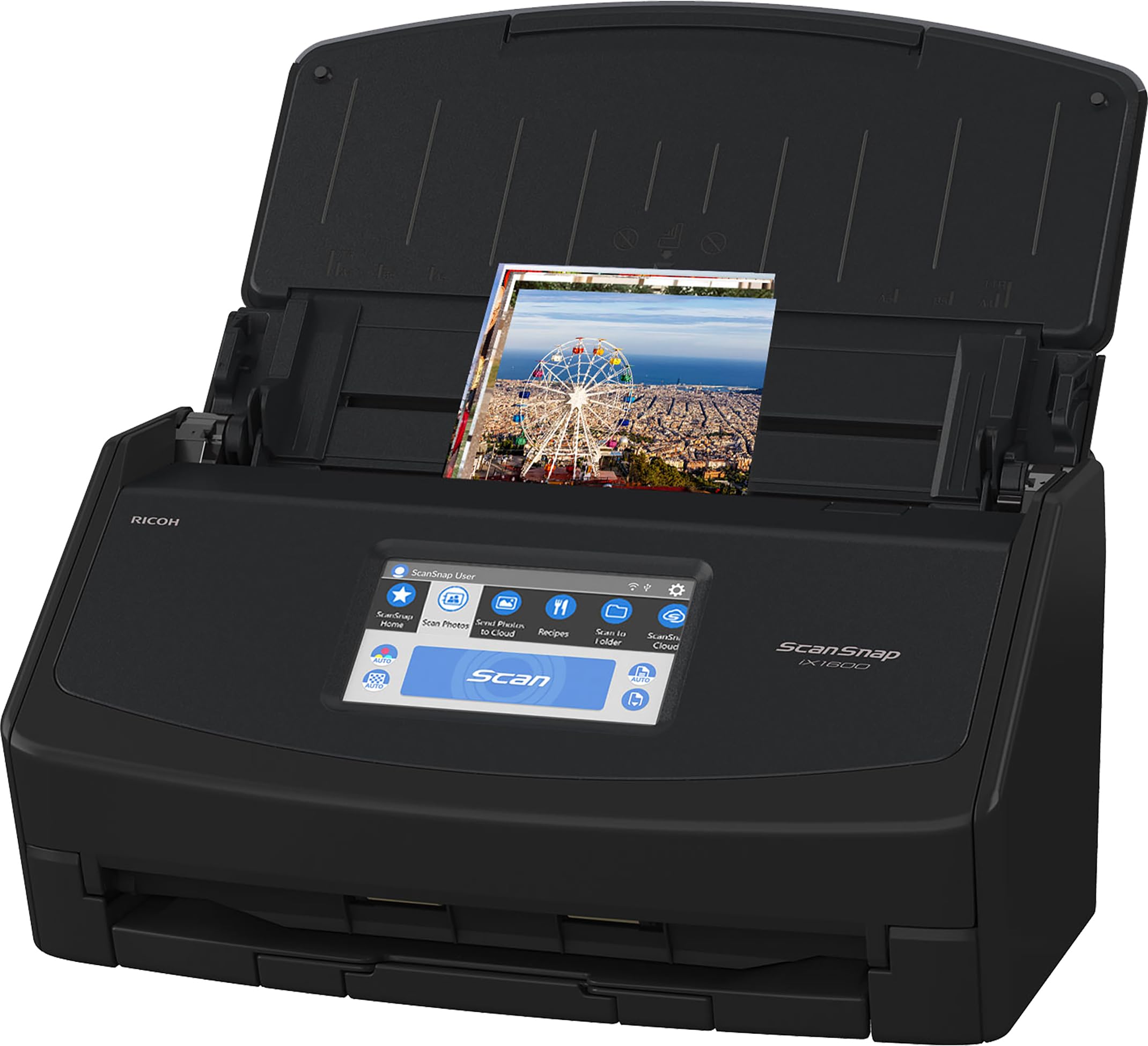
Fujitsu ScanSnap iX1600
$279.99Faster duplex throughput (30 ppm), immediate cloud event firing for workflow automation, and a compact footprint make it the best choice for home-office automation workflows and fast batch scanning of mixed document types.
What you get
- 30 ppm duplex (60 ipm) versus Epson's 25 ppm duplex
- ScanSnap Cloud events fire instantly after scan
- Smaller physical footprint (fits tight desks)
- More responsive large touchscreen
- Better 4.6★ review score with 3K+ data points
The tradeoff
- Only 50-sheet ADF (Epson has 100)
- ScanSnap Cloud SDK is gated (developer agreement required for custom integrations)
- Less mature Windows CLI automation than Epson's Document Capture Pro
- Smaller effective document height may require manual feeding of unusual sizes
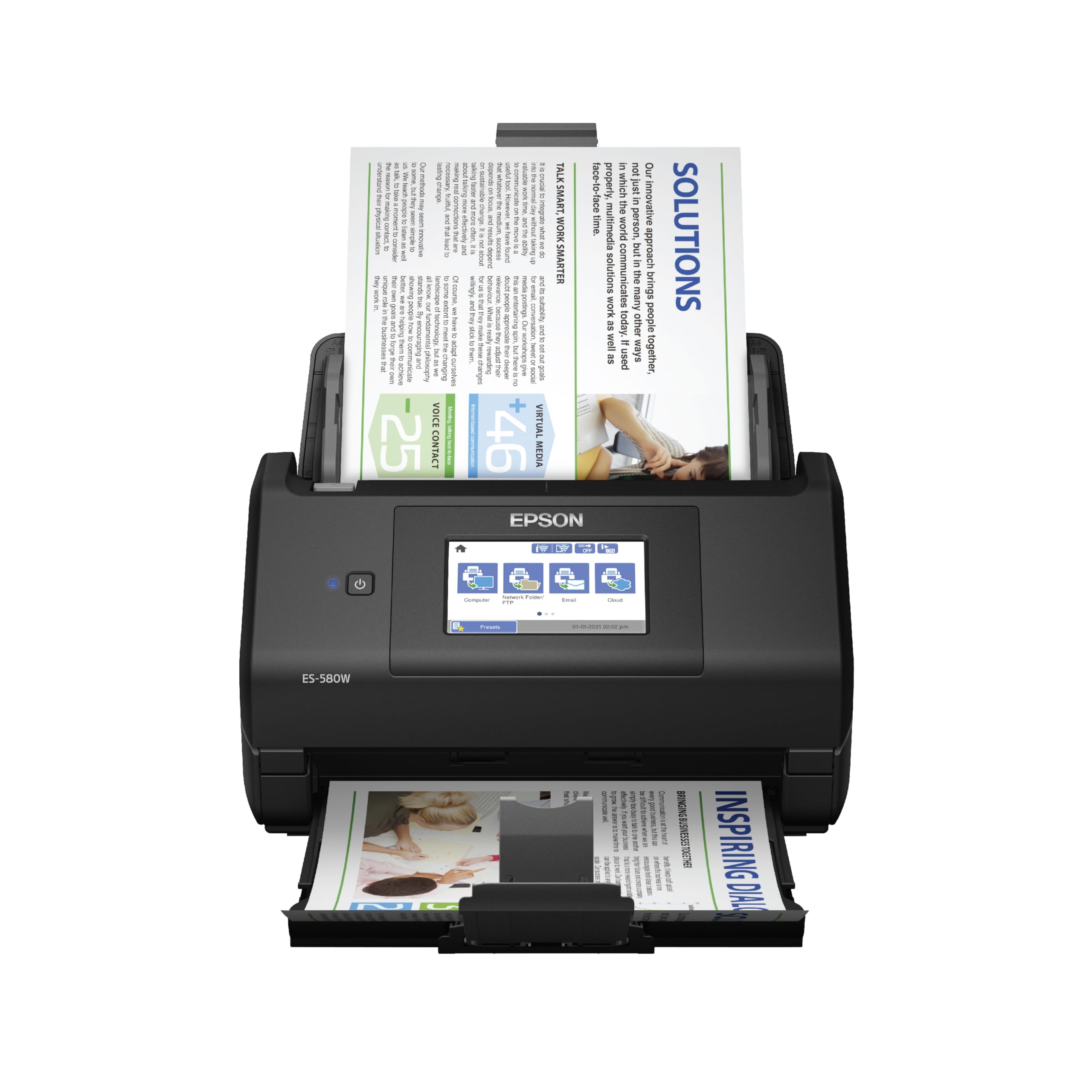
Epson Workforce ES-580W
$379.99100-sheet ADF and Windows-native CLI automation via Document Capture Pro make it ideal for users who batch-scan receipts, invoices, and tax documents without manual feeder reloads. The price premium buys capacity and deeper Windows scripting integration.
What you get
- 100-sheet ADF (double the ScanSnap capacity)
- Document Capture Pro CLI scripting on Windows (PowerShell / Python subprocess integration)
- Epson Connect cloud routing with dedicated route profiles
- Larger footprint handles standard letter and legal sizes with fewer jams
The tradeoff
- Slower duplex speed (25 ppm / 50 ipm vs ScanSnap's 30 ppm / 60 ipm)
- Cloud events are less immediate (polling-based, not event-driven)
- $100 price premium versus ScanSnap
- Fewer reviews (925 vs 3,089) means less real-world data on long-term reliability
Full Spec Comparison
| Specification | Fujitsu ScanSnap iX1600 | Epson ES-580W | Winner |
|---|---|---|---|
| Price | $279.99 | $379.99 | A |
| Duplex ADF | Yes (50 sheets) | Yes (100 sheets) | B |
| Scan Speed (Duplex) | 30 ppm / 60 ipm | 25 ppm / 50 ipm | A |
| Color Scanning | Yes | Yes | Tie |
| Connectivity | USB 3.1 & Wi-Fi (802.11ac) | USB 3.0 & Wi-Fi (802.11ac) | A |
| Cloud Service | ScanSnap Cloud (event-driven) | Epson Connect (polling-based) | A |
| OCR Engine | ABBYY FineReader (bundled) | ABBYY FineReader (bundled) | Tie |
| Touchscreen | Large, responsive | 4.3-inch dedicated panel | A |
| Windows CLI / Scripting | Limited (ScanSnap Home) | Document Capture Pro CLI | B |
| Amazon Rating | 4.6★ (3,089 reviews) | 4.4★ (925 reviews) | A |
| Physical Footprint | Compact (smaller desk impact) | Larger (100-sheet ADF requires space) | A |
Scan Speed and Duplex Throughput
This is where the ScanSnap iX1600 pulls ahead decisively. It scans 30 pages per minute in duplex mode—meaning it processes two-sided sheets at 30 pages/minute, yielding 60 images per minute (ipm). The Epson ES-580W maxes out at 25 ppm duplex (50 ipm).
In practical terms: scanning a 100-page two-sided document stack takes the ScanSnap roughly 3.3 minutes; the Epson takes 4 minutes. Over a month of regular document batches, that 20% speed advantage compounds. The ScanSnap's 50-sheet ADF means one reload; the Epson's 100-sheet capacity means you can feed an entire stack without stopping—so the choice depends on your batch size. If you're scanning 20 pages at a time, speed matters more. If you're scanning 500 pages monthly in one session, the larger feeder's convenience wins.
Both support color scanning at the same speed, so no differentiation there. Both are fast enough for a home office; neither will be a bottleneck if you're not scanning continuously.
Cloud and API Automation Surface
This distinction is crucial for technical home-office buyers. Neither scanner exposes a true REST API or native webhook endpoint—but they differ in how they route events to external systems.
ScanSnap Cloud (Fujitsu): When a document finishes scanning, ScanSnap Cloud fires an immediate event. That event can route the PDF to Dropbox, Google Drive, OneDrive, Box, or Evernote. From there, Zapier or Make can watch the folder and fire a webhook to your automation platform (n8n, Home Assistant, a custom Lambda, etc.). This is event-driven: the moment the scan completes, the cloud notification goes out. The ScanSnap Home SDK exists but requires a developer agreement (gated for commercial use), so this path is off-limits for most home-office users seeking Zapier integration.
Epson Connect (Epson): Epson Connect is more of a routing service—you define static routes (e.g., "send all scans to this SharePoint folder"). It doesn't fire event-driven webhooks. Instead, Zapier or Make must poll the destination folder. That poll-and-react lag introduces a delay: your automation may not trigger for 5–15 minutes after the scan finishes, depending on Zapier's polling interval. Document Capture Pro on Windows does offer a CLI, meaning you can wire PowerShell or Python subprocess calls to the scanner's completion—but that's local-machine scripting, not cloud-based.
For someone building a Zapier workflow to route scanned receipts into a Google Sheet or trigger a Slack notification, the ScanSnap's immediate cloud event is superior. For a Windows user who wants to call a PowerShell script on scan completion and has no interest in cloud-based Zapier, the Epson's CLI is the better fit.
OCR Quality and Bundled Software
Both scanners ship with ABBYY FineReader, so OCR quality is equivalent. Both produce searchable PDFs, extract fields (date, amount, payee from receipts), and export to Word, Excel, or searchable PDF.
ScanSnap Home (Fujitsu): A clean, Mac/Windows desktop app for organizing scans. Supports Shortcuts on Mac and basic automation rules (e.g., "route all scans from profile X to Dropbox folder Y"). Not as deep as scripting, but user-friendly.
Document Capture Pro (Epson): More powerful on Windows. Exposes a command-line interface (CLI) for batch processing and integration with Windows Task Scheduler or PowerShell. Allows you to build custom scan-to-process workflows. On Mac, Epson's offering is less mature—this is a Windows-first tool.
If you need to extract invoice line items and auto-populate an accounting system, both OCR engines will do the heavy lifting. The difference is in routing: Epson's CLI gives you local machine control; ScanSnap's cloud integration gives you immediate remote routing. For a Mac user, ScanSnap's cloud-first approach is less friction-heavy than trying to script Epson's Document Capture Pro on macOS.
Usability — Touch Panel, Button Workflow, Mobile App
The ScanSnap iX1600 has a large, responsive touchscreen that feels snappier than the Epson's 4.3-inch dedicated panel. Both let you select scan profiles (B&W, Color, Photo, Receipt) from the touch interface, but the ScanSnap's larger display makes it easier to read and faster to navigate when you're standing at the machine.
Both have mobile apps (ScanSnap mobile app and Epson's corresponding app). The apps are functional but not the primary interaction point for most home-office users—they're backup conveniences if you're scanning from across the room. The physical touchscreen is what you'll use daily.
Neither has voice control or Bluetooth trigger buttons (common on higher-end office scanners). You're pressing the button on the machine or tapping the screen. The ScanSnap's button placement is slightly more ergonomic for one-handed operation; the Epson's button is functional but less refined.
Value for Money
The ScanSnap iX1600 costs $100 less. For that price, you get faster duplex scanning, a larger touchscreen, event-driven cloud routing, and a smaller footprint. The trade-off: a 50-sheet ADF instead of 100.
The Epson ES-580W costs $100 more. You're paying for:
- A 100-sheet ADF (eliminating mid-batch reloads for large jobs)
- Document Capture Pro CLI scripting on Windows (more direct local-machine control)
- Slightly more robust Epson Connect routing profiles
If you scan 20–50 pages at a time, the ScanSnap's lower price and speed win. If you scan 200–500 pages in one session monthly, the Epson's larger feeder and Windows scripting depth justify the premium.
Consumables (roller kits, pickup separators) are comparable in cost across both brands. Neither has a high failure rate in home-office environments based on review data. Long-term reliability favors the ScanSnap slightly (4.6★ vs 4.4★), but both are dependable for 5+ years of typical home-office use.
Which Should You Buy?
For solo home-office paper management
The ScanSnap iX1600 is the default choice. At $279.99, it's affordable, fast, and the cloud integration is seamless for routing documents to Dropbox or Google Drive. You'll rarely hit the 50-sheet ADF limit in a typical day. The responsive touchscreen and immediate cloud event firing make it feel like a modern tool, not a legacy office appliance.
For feeding AI / LLM workflows (Claude, GPT, n8n pipelines)
Again, the ScanSnap iX1600 is preferable. Scan to ScanSnap Cloud → route to Google Drive → n8n watches the Drive folder → webhook fires → Claude / GPT processes the PDF. The event-driven cloud model means your workflow triggers within seconds of the scan finishing, not minutes. If you're building an invoice-processing pipeline or automating contract review, immediacy matters.
For receipt scanning and tax prep
The Epson ES-580W has a slight edge here. The 100-sheet ADF lets you feed an entire year's worth of receipts (or a quarterly batch) without reloading. ABBYY FineReader on both extracts dates, amounts, and vendor names equally well, so the OCR quality is identical. But the ability to load 100 sheets, walk away, and return to a finished stack is a real convenience for tax-prep season. The Epson's Windows CLI also pairs well with accounting software integrations if you're using Document Capture Pro to auto-route scans to QuickBooks or similar.
For shared small-office Wi-Fi use
Both handle Wi-Fi fine. The ScanSnap iX1600 has USB 3.1 (vs Epson's USB 3.0), and both are 802.11ac. If you have multiple people in a 2–3 person home office, the Epson's larger ADF is more practical—one person loads 100 sheets, and everyone gets to scan without bottlenecking on feeder duty. The ScanSnap's 50-sheet limit means someone reloads halfway through a batch scan, which is annoying in shared settings.
For compact desk footprint
The ScanSnap iX1600 is measurably smaller. If your desk is tight or you have a small filing closet for office equipment, the ScanSnap's compact design matters. The Epson's 100-sheet ADF adds bulk; the scanner occupies more horizontal real estate. On a cramped home-office desk (say, a 48-inch table), the ScanSnap is easier to accommodate.
Final Recommendation
Choose the Fujitsu ScanSnap iX1600 if you value speed, cloud automation, and space efficiency. At $279.99 with a 4.6★ rating backed by 3,089 reviews, it's the safer, faster, and cheaper choice for most home-office buyers.
Choose the Epson Workforce ES-580W if you batch-scan large document stacks, run Windows-centric automation scripts, or need the reassurance of a larger ADF. The $100 premium buys genuine convenience for high-volume use cases and Windows power users.
Either way, you're getting a capable, reliable duplex color scanner with OCR and cloud routing. The wrong choice here isn't a bad purchase—it's just one that doesn't optimize for your specific workflow. Choose based on batch size, automation platform (Zapier/cloud vs. Windows CLI), and desk space, and you won't regret it.
How These Were Selected
Home document scanners for home office were evaluated on eight criteria: duplex (two-sided) scanning in one pass (non-negotiable for bulk scanning — avoids manual page-flipping), ADF capacity (50-sheet is standard, 100-sheet on Fujitsu iX2400), rated speed in ppm/ipm (pages per minute simplex, images per minute duplex — duplex ipm is what actually matters for two-sided docs), connectivity (Wi-Fi plus USB — Wi-Fi lets the scanner route directly to cloud/network folders without a tethered PC), API / SDK / automation surface (ScanSnap Cloud, Epson Document Capture Pro, Brother iPrint&Scan SDK, or watched-folder + OS automation), OCR and searchable-PDF quality (built-in vs dependent on bundled desktop software), form factor and footprint (compact enough for a home desk — roughly 12"×6"×6" is the standard envelope), and review volume (minimum 170+ verified Amazon reviews, 4.3+ stars). Pricing spans compact budget ($230–$330), mid-range duplex ADF ($330–$480), and flagship cloud-enabled ($480–$560). All 16 products were confirmed in-stock on US Amazon as of April 2026.
Common Questions
Which of these scanners can I actually automate with an API or webhook?
None of these scanners expose a REST endpoint or push webhooks directly — that's not a feature any sub-$600 home document scanner ships. What they do support is scan-to-cloud (Dropbox, Box, OneDrive, Google Drive, SharePoint) or scan-to-network-folder. You then wire up the automation downstream: Zapier / Make / n8n watches the cloud folder and fires webhooks; locally, macOS Hazel or Windows Power Automate Desktop does the same against a watched folder. Fujitsu ScanSnap Cloud is the most webhook-friendly because the scan triggers a cloud event the moment the scanner finishes, not when the file syncs.
What's the difference between ScanSnap iX1600 and Epson ES-580W for API use?
The ScanSnap iX1600 uses the ScanSnap Cloud service — scans route through Fujitsu's cloud to your connected service (Dropbox, Evernote, Box, etc.) and THEN your automation fires from that service. The Epson ES-580W uses Epson Connect — it can email, upload to cloud, or drop to a network folder, all configured through the Epson Document Capture Pro app. ScanSnap Cloud has faster cloud-trigger latency (scan-to-event is typically 10–30 seconds); Epson Connect is more flexible about target destinations. For AI workflows, ScanSnap is the more proven path — its Cloud events are documented and stable, and the 3,000+ reviews say so.
Do these scanners have on-board OCR, or does it happen on the PC?
All of these scanners do OCR — but the processing happens in bundled desktop software, not on the scanner itself. ScanSnap uses ABBYY FineReader; Epson uses Epson ScanSmart (which calls Nuance/Kofax engines); Brother uses iPrint&Scan's built-in OCR. The practical implication: the PC/Mac running the software is part of your pipeline. For a fully headless setup (scanner → cloud → webhook, no tethered PC), ScanSnap iX1600 with ScanSnap Cloud is the cleanest path — the cloud service handles OCR before your automation ever sees the file.
Can I trigger a scan from code, or do I always have to press the button?
Physical button press is the standard trigger. For code-initiated scanning, you need the desktop-side SDK: Epson Document Capture Pro exposes a command-line interface on Windows that you can call from PowerShell or Python's subprocess. Brother iPrint&Scan has a scriptable CLI on the ADS-4300N tier and above. ScanSnap has a Windows/macOS SDK but it's gated behind a developer agreement — if you're building a commercial AI workflow, you'll want to apply for that. For scripted triggering on a hobby budget, Epson ES-580W is the best match.
Which scanner is best for feeding documents into an AI / LLM workflow?
The ScanSnap iX1600 with ScanSnap Cloud is the strongest match for AI workflows: scans OCR in the cloud, land in a connected service (Dropbox, Box, OneDrive), and fire a webhook via Zapier / Make to your AI pipeline. End-to-end latency is typically under a minute from button-press to prompt delivery. The Epson ES-580W is the best runner-up: it's cheaper, scans a bit faster on color, and works the same way if you don't mind running Epson Connect. Avoid the very compact models (iX100, ES-C220, Doxie Pro) for AI workflows — their duplex speed is too slow and they rely on a tethered PC for automation.
Is 35 ppm the same as 35 ipm?
No, and it's the most common spec confusion in this category. ppm (pages per minute) is simplex — one-sided pages. ipm (images per minute) is typically duplex — each two-sided page produces two images. A 35 ppm / 70 ipm scanner processes 35 two-sided sheets per minute (producing 70 images). Fujitsu publishes ppm + ipm; Epson publishes ppm + ipm; Brother publishes ppm and notes duplex speed separately. When comparing, always use duplex ipm — it's the real throughput for two-sided documents.
Who This Is For
- Our pick (Fujitsu ScanSnap iX1500 Color Duplex Document) — the right choice for most people who need a duplex scanner for scansnap ix1600 vs epson es 580w. Best balance of speed, API / cloud automation surface, and long-term reliability. If you're not sure which to get, start here.
- Budget pick (Doxie Pro - Duplex Document Scanner) — if you want a compact duplex scanner under $300 and accept slower throughput or a smaller ADF. The core scan quality is still solid; what you trade is speed and some automation polish.
- Premium pick (Fujitsu fi-7160 Professional Desktop Color Duplex) — if you run a high-volume home office or need the strongest cloud / API integration for an AI pipeline. Faster duplex throughput, larger ADF, better software bundle.
- Skip a home scanner entirely if: you scan fewer than 20 pages a week — a multi-function printer's flatbed or a phone scanner app (Scannable, Adobe Scan) is a better fit for low volume. Dedicated scanners earn their keep only at bulk and duplex.
Expert Video Reviews
What YouTube Reviewers Found

Sean Dillman — 38,613+ views · posted 3 years ago. In-depth review covering setup, real-world use, and build quality.
Is the Premium Pick Worth It?
Fujitsu fi-7160 Professional Desktop Color Duplex costs about $704 more than Fujitsu ScanSnap iX1500 Color Duplex Document. Here's what you get for the premium, and whether it's worth it for a home office document workflow:
Bottom line: Upgrade if you need the specific premium feature. Stick with Fujitsu ScanSnap iX1500 Color Duplex Document if you don't hit the premium feature threshold.