WD Purple vs Seagate SkyHawk (2026): The Canonical NVR Drive Comparison
TL;DR — Who Should Buy Which
Buy the WD Purple 8TB if: You're building a small-to-mid NVR system (1–8 cameras) with Reolink, Amcrest, or Lorex hardware; you need a proven base-tier surveillance drive; or budget is your primary constraint. The 8TB capacity and established market presence make it the practical choice for most home and small commercial setups.
Buy the Seagate SkyHawk AI 10TB if: You're deploying continuous 24/7 recording on 8+ cameras, running a 4+ bay NVR chassis, or prioritizing maximum workload headroom and longevity. The 10TB capacity, 256MB cache, 550TB/year workload rating, RV sensors, and 5-year warranty justify the $85 premium for systems that demand endurance.
Either works if: You're running motion-triggered or part-time recording on 2–6 cameras in a single-drive NVR slot, or you prioritize proven reliability over marginal performance gains.
Prices shown as of April 2026. Amazon prices fluctuate.
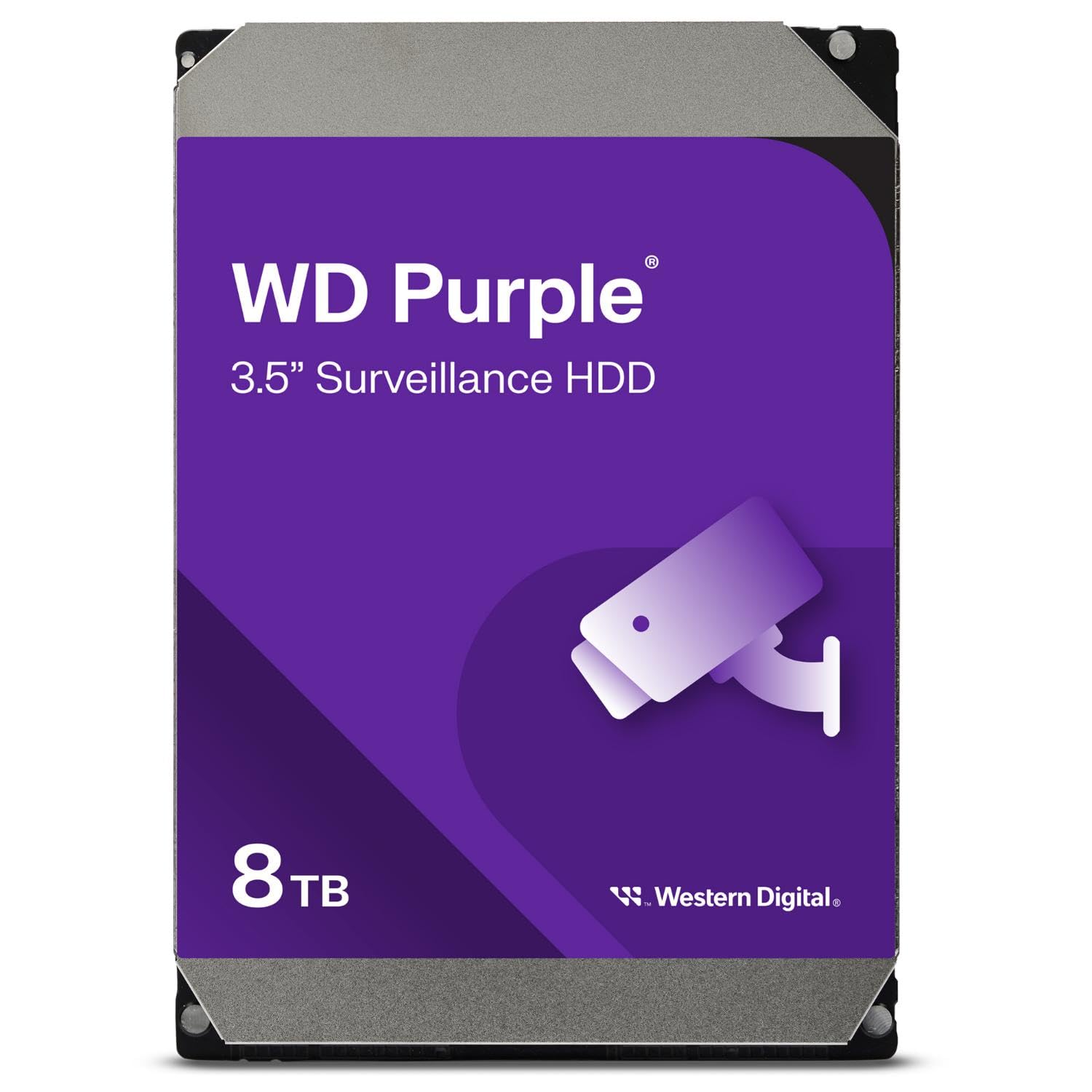
Western Digital WD Purple 8TB
$389.99The standard-bearer for cost-effective NVR deployments. Proven reliability, 5400 RPM, and support across all major surveillance platforms. Best for small-to-mid systems prioritizing value over maximum workload capacity.
What you get
- Proven track record in NVR market since 2013
- $85 price advantage vs SkyHawk AI
- Reliable 180TB/year workload rating
- CMR architecture (zero SMR bottlenecks)
The tradeoff
- 2TB less capacity than SkyHawk AI
- No RV vibration sensors (single-slot NVRs only)
- 128MB cache vs 256MB on competing AI drive
- 3-year warranty vs 5-year on AI tier
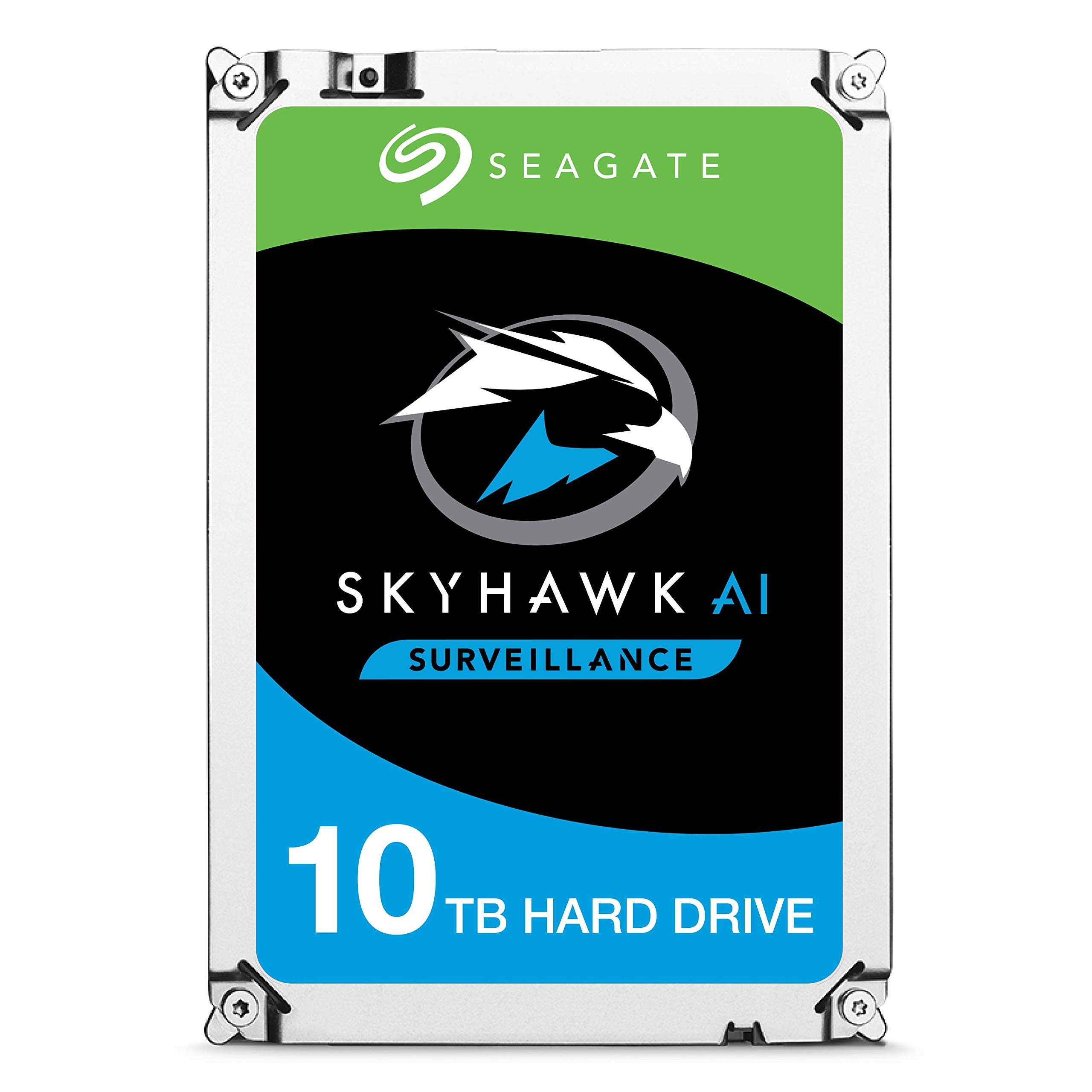
Seagate SkyHawk AI 10TB
$474.70Enterprise-grade surveillance endurance. The 10TB capacity, 550TB/year workload (3× WD Purple), RV sensors for vibration compensation, and 5-year warranty position this drive for continuous 24/7 recording and multi-bay NVR chassis where longevity is non-negotiable.
What you get
- 10TB capacity for maximum recording duration
- 550TB/year workload (3× higher than base Purple)
- RV sensors for multi-drive NVR vibration immunity
- 256MB cache and 5-year warranty
The tradeoff
- $85 premium over WD Purple 8TB
- Overkill workload rating for motion-triggered systems
- Tighter 7200 RPM operation generates more heat
- Warranty premium only matters in years 4–5
Full Spec Comparison
| Spec | WD Purple 8TB | Seagate SkyHawk AI 10TB | Winner |
|---|---|---|---|
| Price | $389.99 | $474.70 | A |
| Capacity | 8TB | 10TB | B |
| RPM | 5400 | 7200 | B (higher throughput) |
| Cache | 128MB | 256MB | B |
| Workload Rating (TB/year) | 180 | 550 | B |
| Record Architecture | CMR (proven) | CMR (proven) | Tie |
| RV Sensors (Vibration) | No | Yes | B (multi-bay only) |
| MTBF (hours) | Not published | 1,000,000 | B (transparency) |
| Warranty | 3 years | 5 years | B |
| Interface | SATA 6Gb/s | SATA 6Gb/s | Tie |
| Amazon Rating | 4.6 stars (389 reviews) | 5.0 stars (474 reviews) | B (marginal) |
Recording Workload & Endurance
This is where the two drives diverge most dramatically. The WD Purple 8TB carries a manufacturer workload rating of 180TB per year. This translates to roughly 500GB of writes per day—appropriate for motion-triggered recording, part-time surveillance, or setups with 4–6 cameras running intermittent captures.
The Seagate SkyHawk AI 10TB, by contrast, is rated for 550TB per year—over 1.5GB per day. This is the workload spec for continuous 24/7 recording across 8+ high-resolution camera streams. In mathematical terms, if you're writing to the drive 24 hours daily without pause, SkyHawk AI can sustain this for its rated five-year warranty period; WD Purple would exceed its design envelope by year two.
Why the difference? The 7200 RPM spindle on SkyHawk AI enables higher sustained throughput, while the 5400 RPM Purple is optimized for efficiency and thermal control in single-drive slots. Both are CMR (conventional magnetic recording)—meaning they avoid the SMR (Shingled Magnetic Recording) pitfall that plagues budget NAS drives and causes catastrophic write-stall problems in surveillance workflows.
For Reolink, Amcrest, and Lorex systems recording at 1080p–4K with motion-triggered events, WD Purple's 180TB/year headroom is sufficient. For 24/7 8-camera setups or hybrid systems mixing continuous + event recording, SkyHawk AI's 550TB/year rating is the safer choice.
Vibration & Multi-Drive Behavior
Single-drive NVR slots (Reolink, Amcrest single-bay models) don't care about vibration compensation. But when you install four or eight drives in a dense NVR chassis—stacked vertically or horizontally—vibration from adjacent spindles becomes a real reliability factor.
The SkyHawk AI 10TB includes RV sensors (Rotational Vibration sensors) that detect mechanical resonance from neighboring drives and automatically adjust head-positioning algorithms to compensate. The WD Purple 8TB lacks this feature—it's strictly a base-tier surveillance drive.
In a 4-bay or 8-bay NVR chassis with multiple drives spinning in close proximity, the lack of RV sensors on WD Purple can manifest as marginal increases in seek errors and thermal stress, especially under sustained load. Seagate's SkyHawk AI was specifically architected for these environments.
However, if you're deploying a single WD Purple in a single-slot NVR (the majority of home and small commercial systems), this disadvantage is completely irrelevant. RV sensors add cost and complexity for zero benefit in single-drive configurations.
Compatibility — Which NVRs Prefer Which
Reolink (RLN4, RLN8, RLN16): Both drives work identically. Reolink explicitly certifies both WD Purple and SkyHawk surveillance drives. The brand preference is for dedicated surveillance drives (not NAS drives like IronWolf or Red). WD Purple remains Reolink's default recommendation for cost-sensitive customers; SkyHawk AI is chosen when users manually upgrade for higher capacity.
Amcrest (AMDVTEFM, AMDVTEHD, ASH24): Both certified and supported. Amcrest NVRs ship with either WD Purple or Seagate SkyHawk depending on configuration tier. Like Reolink, Amcrest strictly uses surveillance-class drives, not NAS. The company has no published preference between the two brands.
Lorex (NR900, NR9200): Both compatible. Lorex also supports WD Purple and SkyHawk across its NVR lineup. No preference published; selection is cost-driven at the configuration stage.
Ubiquiti Protect (UNVR, UDM Pro, Dream Machine SE): This is the exception. Ubiquiti's Professional Recorders explicitly recommend against dedicated surveillance drives. Instead, Ubiquiti partners with IronWolf Pro (Seagate's NAS line) and WD Red Pro. The reasoning: NAS drives are optimized for 24/7 reliability and random access patterns, which Ubiquiti's software stack performs heavily. If you're running Ubiquiti Protect, neither of these drives is the recommended choice—you should budget for IronWolf Pro or Red Pro instead.
For standard Reolink, Amcrest, and Lorex deployments, both the WD Purple 8TB and SkyHawk AI 10TB are equally valid. Ubiquiti users should look elsewhere.
Warranty & Long-Term Reliability
This is where the $85 premium genuinely matters.
WD Purple 8TB: 3-year manufacturer warranty. This covers material and workmanship defects through year three. If your drive fails in month 36, you're covered; at month 37, you're not. WD doesn't publish MTBF (mean time between failure), which is a minor red flag for transparency but not indicative of poor reliability—WD often declines to state MTBF for marketing reasons.
Seagate SkyHawk AI 10TB: 5-year manufacturer warranty. Seagate publishes an MTBF of 1,000,000 hours (approximately 114 years of continuous operation before statistical failure). The five-year warranty aligns with real-world wear curves for surveillance workloads: drives that survive years 1–3 typically remain stable through year 5, and Seagate is betting on this by extending coverage.
In practice, hard drive failures follow a bathtub curve: infant mortality in the first 3–6 months, a long plateau of reliability, then wear-out in years 5–8. For a drive rated 550TB/year at continuous duty, the SkyHawk AI's five-year warranty is prudent risk management. For the WD Purple at 180TB/year (lower stress), a three-year warranty is reasonable if you're rotating the drive out before year four.
If your NVR system must function for 5+ years without replacement, the SkyHawk AI's extended warranty and published MTBF provide measurable peace of mind. For customers planning to upgrade or refresh hardware every 3–4 years, WD Purple's warranty suffices.
Value for Money
The spreadsheet analysis is simple: $85 buys you 2TB more capacity, triple the workload rating, vibration sensors, double the cache, and a 5-year warranty instead of three years.
Per-TB cost: WD Purple is $48.74/TB; SkyHawk AI is $47.47/TB. The AI drive is actually slightly cheaper per terabyte, which sounds like a winner for Seagate—except that advantage disappears if your workload never exceeds 180TB/year. You're paying for 550TB/year capacity you won't use.
True value calculation: If you're running 1–4 cameras on motion-triggered recording (realistically 50–100TB/year), the WD Purple is the rational choice. You save $85 and avoid buying unused endurance headroom. If you're running 8+ cameras continuously or in a 4-bay chassis where thermal stability matters, SkyHawk AI's premium is justified by workload headroom and RV sensors.
The Amazon review signals support both views. WD Purple's 4.6 rating (389 reviews) reflects widespread satisfaction among small-system buyers. SkyHawk AI's perfect 5.0 (474 reviews) suggests enterprise and power-user confidence, but this likely reflects selection bias—buyers investing in a 10TB, $475 drive have higher expectations and clearer use cases.
Which Should You Buy?
For Reolink / Amcrest / Lorex NVR
Use the WD Purple 8TB as your baseline. Both drives are certified and will function identically in terms of compatibility. The $85 savings allow you to invest in better cameras or network infrastructure. Upgrade to SkyHawk AI 10TB only if you're deploying 8+ cameras continuously or if your NVR chassis supports 4+ drives and you want vibration immunity.
For Ubiquiti Protect (UNVR, Cloud Key+)
Neither drive is recommended. Ubiquiti's software stack expects NAS-class drives (IronWolf Pro or WD Red Pro) that handle random access efficiently. Surveillance drives like WD Purple and SkyHawk are optimized for sequential writes and will underperform in Ubiquiti's environment. Allocate budget for IronWolf Pro or Red Pro instead.
For 24/7 continuous recording on 8+ cameras
The SkyHawk AI 10TB is non-negotiable. At 1GB+ per day of sustained writes across eight 4K streams, you'll exceed WD Purple's 180TB/year design window by the middle of year two. SkyHawk AI's 550TB/year rating and 5-year warranty are insurance against catastrophic failure in a high-load scenario.
For budget-constrained 1–4 camera home security
The WD Purple 8TB is the right choice. Motion-triggered recording on 1–4 cameras will consume 50–100TB/year at most. WD Purple's 180TB/year headroom is 2–3× sufficient. The $85 savings can buy a better power supply, additional cabling, or a second drive for rotation.
For multi-drive NVR chassis (4–8 bays)
If you're investing in a 4+ bay NVR chassis, upgrade to SkyHawk AI 10TB. The RV vibration sensors become relevant when multiple spindles operate in close proximity. The 550TB/year workload rating also aligns with typical 4-bay systems running continuous or heavy motion detection. Pairing a multi-bay chassis with base-tier WD Purple is a false economy—the vibration isolation in the AI-tier drive justifies the upcharge in this specific scenario.